Loading…
Loading…Development Insights
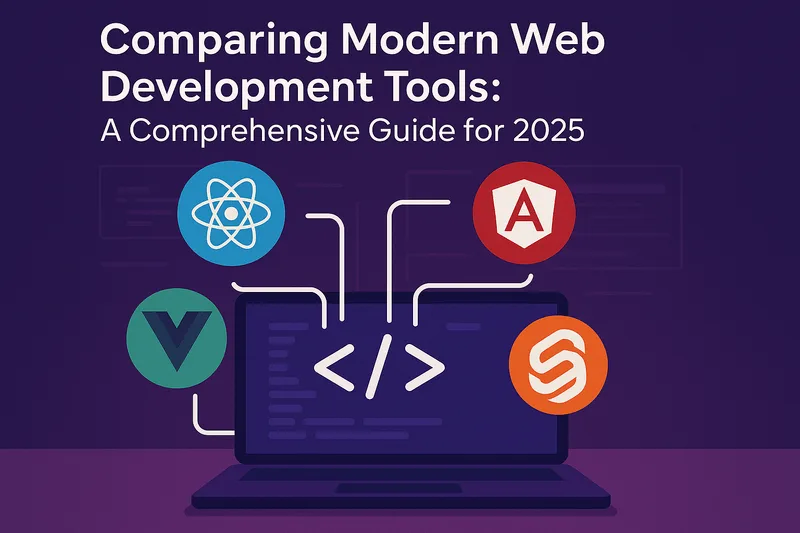
Comparing Modern Web Development Tools: A Comprehensive Guide for 2025
Web development technology evolves rapidly. This guide examines the most influential platforms and frameworks in 2025, helping you make informed technology decisions.
Avishek Kedia
Founder & CEO, Airful
Web development technology evolves rapidly, making it essential for businesses and developers to understand current tools' capabilities and constraints. This comprehensive guide examines the most influential platforms in 2025 across multiple categories.
Traditional JavaScript Frameworks
React
Strengths:
- High performance for complex applications
- Extensive ecosystem with countless libraries
- Strong community support and documentation
Limitations:
- Steep learning curve for beginners
- Requires additional libraries for routing, state management
- Higher development costs for simple projects
Vue.js
Strengths:
- Beginner-friendly with gradual learning path
- Built-in state management with Vuex/Pinia
- Excellent documentation
Limitations:
- Smaller ecosystem than React
- Fewer enterprise-level resources
Angular
Strengths:
- Complete solution out of the box
- Enforces code quality and structure
- Excellent for large teams
Limitations:
- Steepest learning curve of the three
- Verbose development process
Emerging Frameworks
Svelte
Svelte offers exceptional performance with smaller bundle sizes and intuitive reactive programming. However, it has a more limited ecosystem compared to established frameworks.
Qwik
Qwik provides a revolutionary approach to page loading performance with instant loading capabilities. It requires rethinking traditional development patterns but delivers outstanding user experience.
Visual Development Platforms
Webflow
Professional-grade visual design with no-code CMS functionality. Excellent for marketing sites and portfolios, though less suitable for highly dynamic applications.
Framer
Superior animation capabilities with React component support. Great for interactive prototypes but offers limited CMS functionality.
Wix Studio
Comprehensive business features and e-commerce capabilities. Less flexible than Webflow for custom designs but excellent for small business needs.
Full-Stack Solutions
Next.js
Next.js has become the de facto standard for React-based applications. It offers flexible rendering options (SSR, SSG, ISR), built-in API routes, and excellent developer experience.
Nuxt
The Vue equivalent of Next.js, providing similar capabilities with excellent documentation and a growing ecosystem.
Decision Framework
When selecting development tools, consider:
- Project complexity: Simple sites vs. complex applications
- Team resources: Available expertise and learning capacity
- Time constraints: Speed to market requirements
- Budget: Development and maintenance costs
- Maintainability: Long-term support and updates
Conclusion
Successful modern development often combines both coded and visual approaches strategically. The best tool is the one that matches your specific project requirements, team capabilities, and business objectives.
Related Posts
The Design Principles of AI-Native Companies
AI-native companies are designed around objective-first workflows, source-of-truth discipline, narrow agents, explicit handoffs, audit trails, and continuous measurement.

The AI-Native Growth Stack
An AI-native growth stack connects CRM, enrichment, scoring, content, answer-engine visibility, lifecycle messaging, and measurement into one compounding system.
How to Build an AI-Native Company: The Operating Model
An AI-native company is not a normal company with AI tools added. It is an operating model where objectives, context, systems, agents, and human judgment are designed as one execution layer.

Ready for a clearer growth plan?
Book a 30-minute audit call. We review your current stack and recommend the first module. No generic sales pitch, no 12-page proposal.