Loading…
Loading…AI Innovation
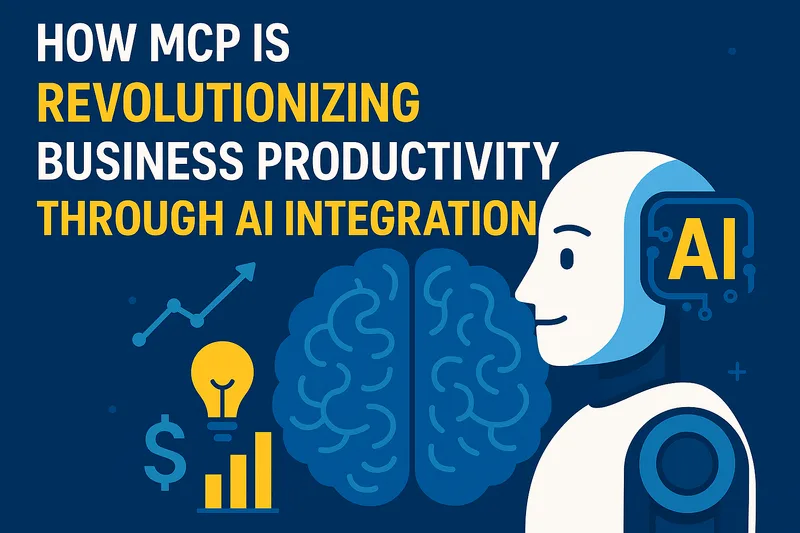
How MCP is Revolutionizing Business Productivity Through AI Integration
Explore how Model Context Protocol (MCP) is fundamentally changing how companies interact with AI systems, creating new possibilities for productivity and integration.
Avishek Kedia
Founder & CEO, Airful
Model Context Protocol (MCP) represents an innovative framework that's fundamentally changing how companies interact with AI systems. For organizations seeking improved productivity through enhanced AI implementation, understanding MCP is becoming increasingly important.
What Exactly is MCP?
MCP functions as a standardized communication framework between humans, applications, and AI models. Think of it as the translator that ensures everyone in the conversation—whether human, software, or AI—is speaking the same language and remembering the same things.
This creates structured context management across interactions, allowing AI systems to maintain relevant information and provide more coherent, useful responses over time.
The Productivity Problems MCP Solves
Organizations face several key challenges when implementing AI:
- Inconsistent interactions across different AI touchpoints
- Context loss between systems or sessions
- Integration difficulties with existing workflows
- Inefficient AI utilization from redundant prompting
- Privacy and security concerns during AI leverage
MCP addresses each of these by providing a standardized layer for managing AI interactions.
How MCP Transforms Business Productivity
1. Seamless Context Retention
MCP maintains context across interactions, eliminating the need to re-explain background information. Teams can pick up where they left off, whether switching between tools or resuming work the next day.
2. Enhanced Human-AI Collaboration
Standardized information sharing means AI assistants have the context they need to provide genuinely helpful responses. Less time is spent on prompting; more time is spent on productive work.
3. Integration with Existing Systems
MCP connects naturally with CRMs, project management tools, documentation systems, and other business software. AI becomes part of your workflow, not a separate destination.
4. More Precise AI Outputs
With proper context, AI generates more accurate, relevant results. Organizations report reducing editing and revision time by up to 40% when implementing MCP-based systems.
5. Consistent Experience Across Tools
Whether using ChatGPT, Claude, or specialized AI tools, MCP ensures consistent context and behavior across your AI ecosystem.
Real-World Impact
Early adopters are seeing significant results:
- Financial services: 35% increase in analyst productivity
- Software development: 50% reduction in documentation time
- Healthcare: 28% improvement in patient record processing
Implementation Steps
- Assess your current AI ecosystem — Identify tools, workflows, and pain points
- Identify high-value use cases — Focus on areas where context retention matters most
- Build supporting infrastructure — Ensure data systems can support MCP requirements
- Prioritize user training — Help teams understand and leverage new capabilities
- Measure and iterate — Track productivity metrics and optimize
Conclusion
MCP represents more than a technical standard—it's a competitive advantage. By transforming AI from isolated tools into integrated productivity multipliers, organizations can unlock the full potential of their AI investments.
Related Posts

The Design Principles of AI-Native Companies
AI-native companies are designed around objective-first workflows, source-of-truth discipline, narrow agents, explicit handoffs, audit trails, and continuous measurement.
How to Build an AI-Native Company: The Operating Model
An AI-native company is not a normal company with AI tools added. It is an operating model where objectives, context, systems, agents, and human judgment are designed as one execution layer.
AI Operating Systems: Why the Next Billion-Dollar Companies Will Be AI-Native
An AI Operating System lets software operate on behalf of people, not just assist them — why the next billion-dollar companies will be AI-native.

Ready for a clearer growth plan?
Book a 30-minute audit call. We review your current stack and recommend the first module. No generic sales pitch, no 12-page proposal.