Loading…
Loading…RevOps Excellence
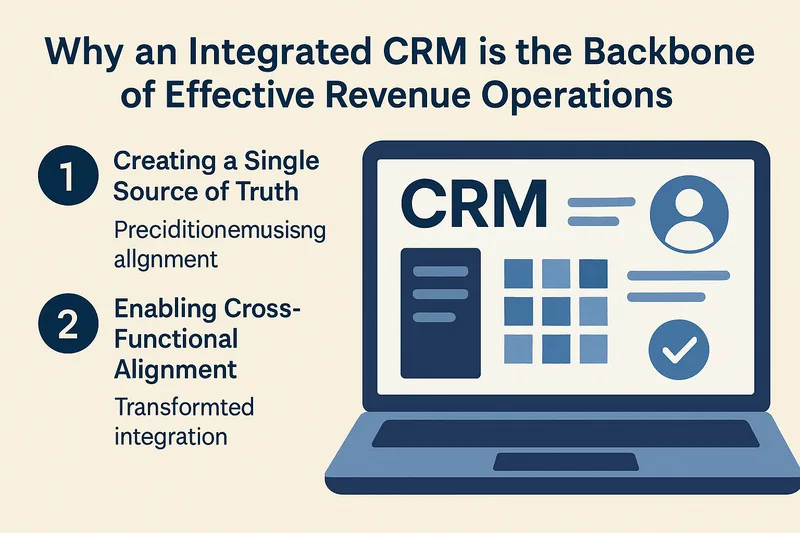
Why an Integrated CRM is the Backbone of Effective Revenue Operations
Discover how a strategically implemented CRM system serves as the central nervous system for revenue operations, enabling data-driven decision making and sustainable growth.
Avishek Kedia
Founder & CEO, Airful
Customer Relationship Management systems have evolved far beyond basic contact databases. Modern CRMs function as the central nervous system for revenue-generating activities across your organization, orchestrating every customer interaction from first touch to long-term retention.
Five Ways an Integrated CRM Powers Revenue Operations
1. Creating a Single Source of Truth
An integrated CRM establishes unified customer data across all departments. This eliminates conflicting information between teams and enables complete visibility into the customer journey—from initial marketing touch through sales conversion to ongoing success management.
2. Enabling Cross-Functional Alignment
By centralizing workflows and communication, a well-implemented CRM dissolves the traditional silos between marketing, sales, and customer success. Teams share context, handoffs become seamless, and the customer experiences a unified brand relationship.
3. Automating the Revenue Engine
Manual processes drain productivity and introduce errors. Modern CRMs automate critical workflows including:
- Lead routing and assignment
- Follow-up sequences and reminders
- Customer health monitoring
- Renewal and expansion triggers
4. Driving Data-Informed Decision Making
With all customer interactions consolidated, leadership gains unprecedented analytics capabilities. Track conversion rates across segments, identify pipeline leaks, understand customer behavior patterns, and forecast revenue with confidence.
5. Scaling Personalized Experiences
As your customer base grows, maintaining personalized engagement becomes challenging. CRMs capture context that enables relevant communication at every touchpoint, from personalized email campaigns to informed sales conversations.
Common Pitfalls to Avoid
- Poor data hygiene: Garbage in, garbage out
- Inadequate adoption: Technology only works when people use it
- Misaligned processes: Technology should support process, not dictate it
- Disconnected systems: Integration gaps create data silos (see the real cost of tool sprawl)
- Lack of executive sponsorship: RevOps transformation requires leadership commitment
Strategic Principles for Success
- Start with process before technology — Understand your workflows before configuring tools (we cover this in depth in why most CRM implementations fail)
- Prioritize integration — Connect your CRM with critical business systems
- Focus on adoption — Demonstrate value to users to drive engagement
- Implement robust data governance — Establish standards and maintain quality
- Build for analytics — Design with reporting needs in mind from day one
Looking Forward
AI and machine learning are advancing CRM capabilities toward predictive insights and automated decision-making. Organizations that build strong CRM foundations today will be best positioned to leverage these emerging capabilities tomorrow.
Related Posts

Investor Intelligence: How to Score 800 Family Offices in a Week
Most early-stage fundraising teams pick LPs by gut feel and warm intros. Here's what changes when you replace that with structured scoring across hundreds of family offices, RIAs, and impact funds.
Why Most CRM Implementations Fail (And How to Get Yours Right)
70% of CRM implementations miss their goals. Here are the failure patterns we see repeatedly, and a framework that actually works — based on the projects we've rescued and built.

The Design Principles of AI-Native Companies
AI-native companies are designed around objective-first workflows, source-of-truth discipline, narrow agents, explicit handoffs, audit trails, and continuous measurement.

Ready for a clearer growth plan?
Book a 30-minute audit call. We review your current stack and recommend the first module. No generic sales pitch, no 12-page proposal.