Loading…
Loading…Business Transformation

The Real Cost of Tool Sprawl in Growing Companies
The average 50-person company uses 40+ SaaS tools. Most of them overlap, none of them talk to each other properly, and the integration tax is quietly eating your margins.
Avishek Kedia
Founder & CEO, Airful
Here's a number that surprises people: the average 50-person company runs 40 to 60 SaaS tools. Not including the free tools people sign up for without telling anyone. The total SaaS spend is usually between $300K and $800K per year, spread across so many credit cards and billing cycles that nobody has an accurate count.
But the dollar cost is the smaller problem. The real cost is what I think of as the integration tax. The cumulative time, energy, and friction your team absorbs trying to make disconnected tools work together.
Every spreadsheet is a confession that your tools don't talk to each other.
How it happens
Nobody plans for tool sprawl. It's emergent. Always follows the same pattern.
Someone on the team hits a workflow problem. They find a tool with a free trial, sign up, and it solves their specific problem. They tell a few colleagues. The tool works well enough that the team adopts it. It gets a paid plan. Someone becomes the informal admin. Workflows get built around it.
Then another team has a similar problem. They don't know about the first tool, or don't like it. They adopt a different one. Now you have two tools doing roughly the same thing for different groups.
The two tools need to share data. Someone sets up a Zapier workflow, or writes a script, or starts manually copying data between them. This works until it doesn't.
By now both tools have months of data, custom workflows, and team familiarity baked in. Consolidating feels harder than maintaining the status quo. So you maintain the status quo. Multiply this by every function in the company and you have tool sprawl. (This is one form of process debt, and it compounds the same way.)
What the integration tax actually costs
The direct time cost is the most measurable one. Every manual data transfer, every copy-paste between systems, every "let me pull that up in the other tool." In a recent engagement, we tracked a 45-person company's integration overhead for two weeks. 62 hours per week went to activities that existed solely because tools didn't communicate. Reconciling data, reformatting reports, manually triggering workflows that should have been automatic. That's 1.5 FTEs of wasted labor. Roughly $150K per year in salary going to compensate for tool fragmentation.
Decision latency is harder to measure but just as expensive. When data lives in six places and none of them agree, every decision starts with a data reconciliation exercise. "Wait, which number is right? The CRM says 400 leads but the marketing tool says 520." This slows strategic decisions, erodes trust in data, and trains your team to rely on gut feel instead of metrics.
Onboarding drags too. A new hire at a 50-person company needs access to 12-15 tools to do their job. Each with its own login, its own interface logic, its own quirks. The cost isn't just IT provisioning. It's the cognitive load of learning how 15 systems connect (or don't). Companies with bad tool sprawl consistently report three months to productivity for new hires instead of six weeks. The tools aren't harder individually. It's the constellation that's overwhelming.
And the security surface area grows silently. Every tool with access to company data is a potential vulnerability. Most companies with tool sprawl don't have a complete inventory of what tools exist, who has admin access, or what data each tool can reach. Shadow IT isn't malicious. It's just people trying to do their jobs.
How to fix it
Fixing tool sprawl isn't about picking one magic platform that does everything. That doesn't exist, and the attempts to build it always end in mediocrity.
Start with an inventory. Pull every SaaS charge from your credit cards and expense reports for the last 12 months. You will be surprised. Every company I've done this with discovers tools they didn't know they were paying for. For each one, write down what team uses it, how many active users, annual cost, what data it holds, and what it integrates with. This inventory alone usually justifies the exercise.
Then define your system of record for each data type. This is the same principle behind good CRM implementation. For any piece of business data (customer, deal, employee, project, invoice), where is the single source of truth? Not where it's entered first, or where it's most convenient to view. Where is the authoritative record? Most tool sprawl problems trace back to ambiguous answers to this question. When three tools all claim to be the customer database, everyone suffers.
When you're ready to consolidate, evaluate by workflow, not by feature. The mistake most companies make is comparing feature lists. Tool A has 50 features, Tool B has 80, therefore Tool B is better. This is backwards. Evaluate tools by how well they support your actual workflows end-to-end. A tool with 30 features that covers your critical path natively is better than a tool with 100 features that requires Zapier to do what you actually need.
Migrate one workflow at a time. Pick the one with the most visible pain and the least political complexity. Clean migration, prove the value, then move to the next. Early wins build the internal support you'll need for harder migrations later.
What it looks like on the other side
The companies I've seen get this right end up with a core stack of 8-12 tools covering 90% of their workflows natively, plus a handful of specialized tools for specific functions. Every piece of data has one source of truth and a defined path to everywhere it needs to go. When tools need to connect, it's through native integrations, not Zapier hacks. One person owns the tool stack and approves new additions. Once a year, they audit usage. If a tool has fewer than 5 active users and costs more than $5K, it needs to justify its existence.
Tool sprawl is inevitable as companies grow. The question isn't whether it happens. It's how long you let it run before you deal with it.
You're probably paying for tools you've forgotten about — and losing hours to ones that don't talk to each other. One conversation usually uncovers enough waste to justify the whole audit.
Book a Free Discovery SessionRelated Posts
When Process Debt Kills Scaling Companies
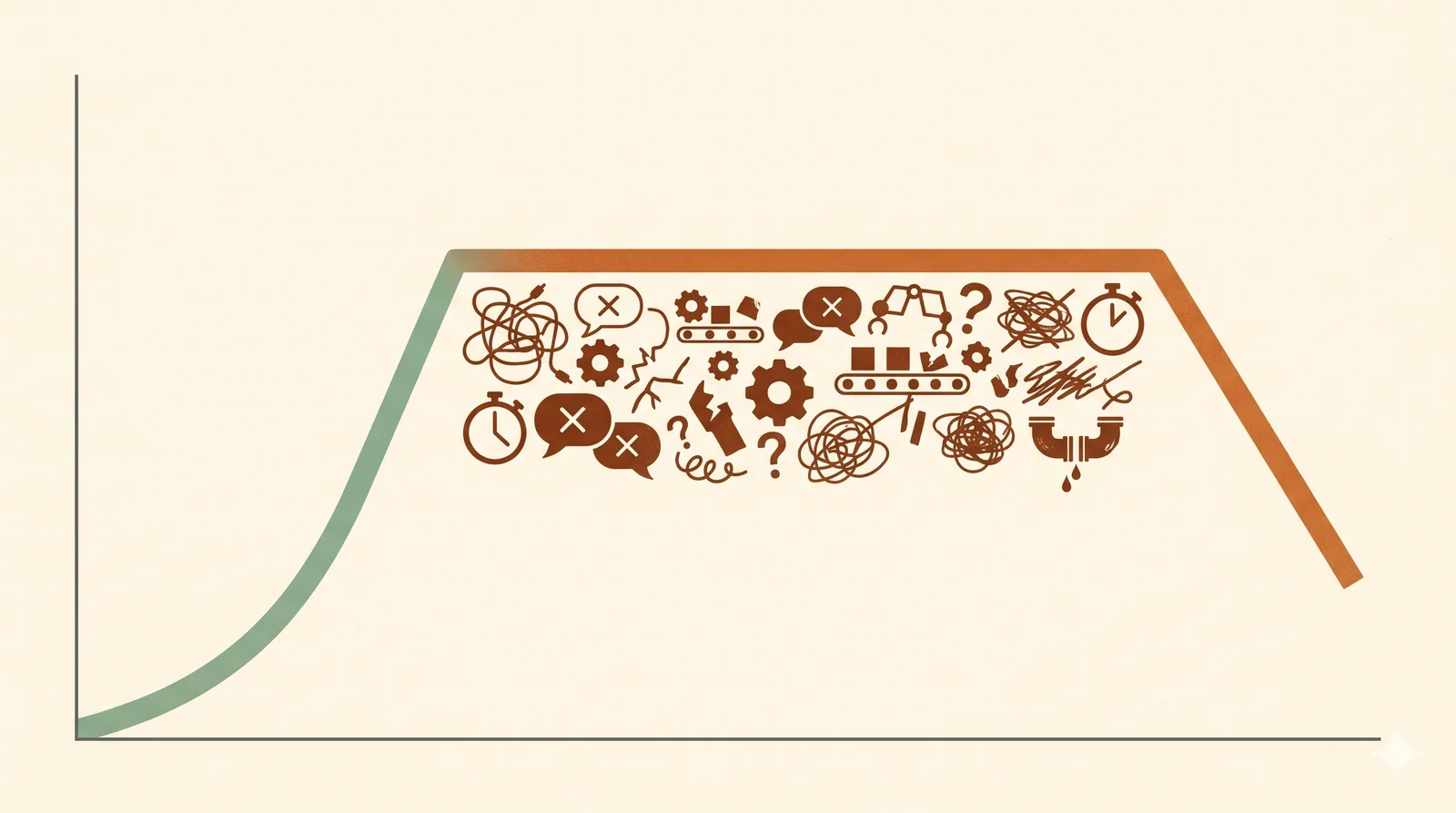
Every company has process debt. The workarounds, manual steps, and tribal knowledge that worked at 10 people but collapse at 50. Here's how to spot it before it becomes a crisis.
Fractional Leadership: When It Works and When It Doesn't
Fractional CMOs, CTOs, and COOs are everywhere now. But the model isn't magic. It works brilliantly in some situations and fails quietly in others. Here's what separates the two.
The Design Principles of AI-Native Companies
AI-native companies are designed around objective-first workflows, source-of-truth discipline, narrow agents, explicit handoffs, audit trails, and continuous measurement.

Ready for a clearer growth plan?
Book a 30-minute audit call. We review your current stack and recommend the first module. No generic sales pitch, no 12-page proposal.