Loading…
Loading…RevOps Excellence
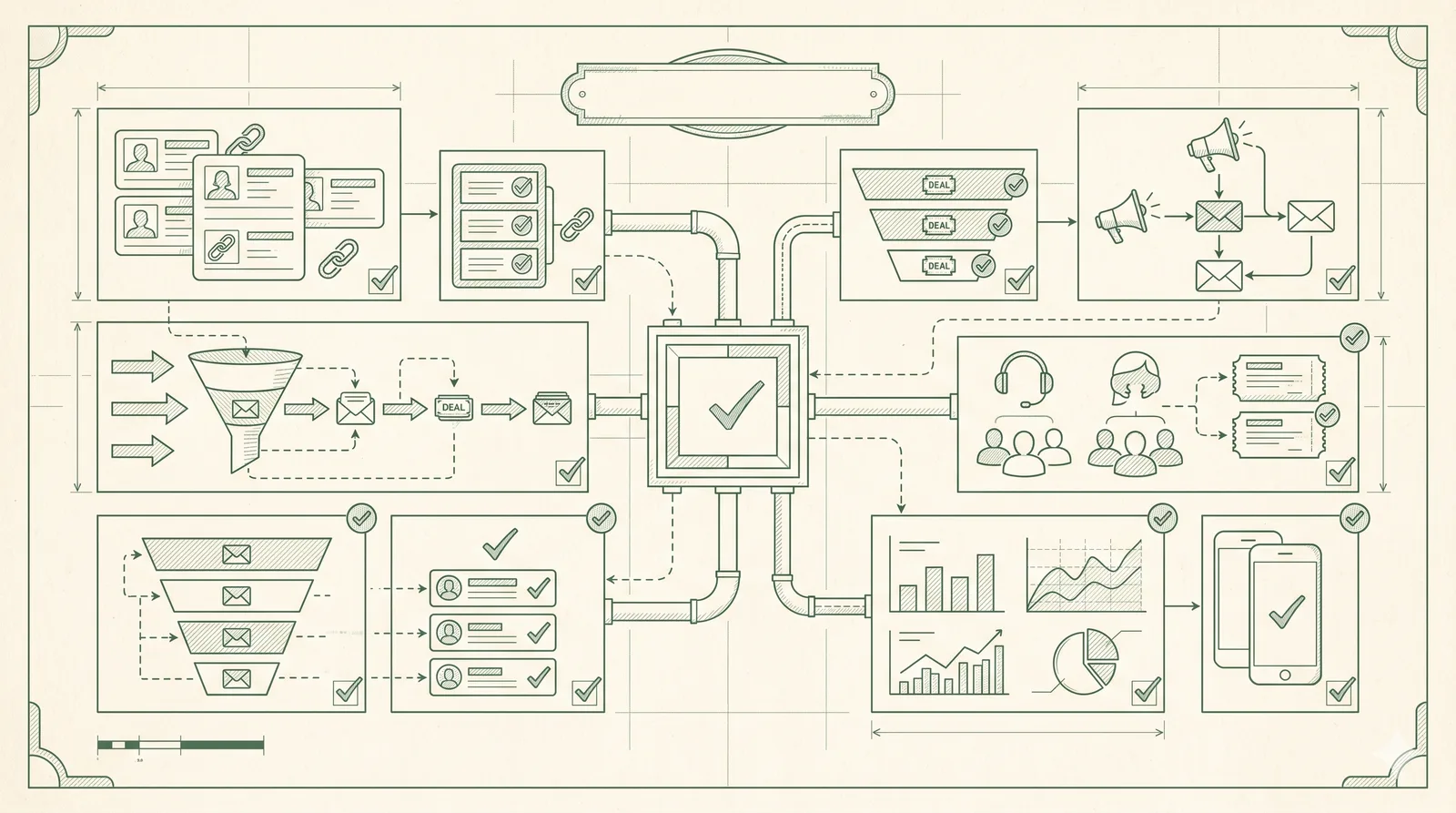
Why Most CRM Implementations Fail (And How to Get Yours Right)
70% of CRM implementations miss their goals. Here are the failure patterns we see repeatedly, and a framework that actually works — based on the projects we've rescued and built.
Avishek Kedia
Founder & CEO, Airful
Here's a number that should bother anyone about to invest in a CRM: roughly 70% of CRM implementations fail to meet their stated objectives. Not "kind of miss the mark." Fail. The system gets deployed, people grudgingly use parts of it, and eighteen months later the data is a mess, adoption is spotty, and leadership wonders what happened to the ROI they were promised.
I've been involved in enough CRM projects — both rescuing failed ones and building new ones from scratch — to see the same failure patterns repeat. The good news is they're preventable. The bad news is they require discipline in areas that aren't especially exciting.
The five failure patterns
1. Tech-first thinking
This is the most common one. A company decides they need a CRM. They spend three months evaluating platforms, comparing feature lists, attending demos, and negotiating contracts. They pick the tool. They hand it to IT or an admin to configure. Then they discover that the tool doesn't match how anyone actually works.
The platform was never the hard part. The hard part is understanding what you need the system to do before you pick the system. When you start with technology, you end up bending your processes to fit the tool. When you start with process, you pick the tool that fits your processes. (We wrote more about this in Build vs. Buy.)
I watched a 60-person company spend $120K on a CRM platform because it had the most features on the comparison spreadsheet. Six months after launch, they were using maybe 15% of the functionality. The features they needed most — a specific deal stage workflow and custom reporting by region — required expensive consultants to configure because nobody had mapped those requirements before signing the contract.
2. The adoption cliff
You build it. Nobody comes. Or more accurately, people use it for two weeks because they were told to, then quietly go back to their spreadsheets and email folders.
Adoption fails for predictable reasons. The system is harder to use than whatever people were doing before. It wasn't designed with their daily workflow in mind. There's no clear answer to "what's in it for me?" from the individual rep's perspective. Training was a one-time event rather than an ongoing support structure.
The people most affected by a CRM — usually sales reps — are also the people with the least patience for tools that slow them down. If logging an activity in the CRM takes four clicks and 90 seconds, and the rep doesn't see how that effort benefits them personally, they'll stop doing it. Then your data degrades. Then your reports become unreliable. Then leadership loses trust in the system. It's a predictable spiral.
3. Data migration chaos
Every CRM implementation involves moving data from somewhere — old CRM, spreadsheets, email, notebooks, someone's memory. This step is consistently underestimated.
The problems usually aren't technical. The problems are duplicate records that nobody cleaned up, inconsistent naming conventions (is it "IBM" or "International Business Machines" or "IBM Corp"?), missing fields that were never required in the old system, and historical data that doesn't map cleanly to the new data model.
One client migrated 40,000 contacts from a legacy system. After migration, they discovered that 12,000 had no email address, 8,000 were duplicates, and 3,000 had been assigned to sales reps who'd left the company years ago. They spent six weeks cleaning data that should have been cleaned before migration.
4. Scope creep
CRM projects have a gravity that pulls in every adjacent problem. "While we're at it, can we also rebuild our quoting process? And integrate the support ticketing system? And set up marketing automation? And build a customer portal?"
Each addition seems reasonable in isolation. Together, they transform a focused 3-month CRM rollout into an 18-month IT project that tries to solve every problem at once and solves none of them well. The project gets delayed. Costs balloon. People get frustrated. By the time it launches, half the team has lost confidence in it.
5. No process mapping
This is related to tech-first thinking but deserves its own entry. Many companies implement a CRM without first documenting how leads move through their pipeline, how deals get handed off between teams, what triggers a follow-up, or who's responsible for what at each stage.
The CRM then gets configured based on assumptions and defaults rather than documented reality. Six months later, the pipeline stages don't match the actual sales process, the required fields don't capture what matters, and the automation fires at the wrong moments.
A framework that works
After enough failed and successful implementations, a pattern emerges in what the successful ones do differently. It's not complicated, but it requires doing things in a specific order.
Step 1: Process audit first
Before you touch any CRM, document your current processes. Not how you think they should work — how they actually work today. Sit with your sales reps and watch them sell. Sit with your support team and watch them handle tickets. Map the handoffs between marketing, sales, and customer success.
You'll find gaps. You'll find process debt — steps that exist only because one person started doing them three years ago and everyone assumed it was policy. You'll find that the process differs between your best reps and your average reps. All of this is useful.
The deliverable from this step is a process map that everyone agrees on. Not a 50-page document — a clear diagram of how a lead becomes a customer, with the actions, triggers, and handoffs identified.
Step 2: Stakeholder alignment
Before evaluating platforms, get agreement on what the CRM needs to do (not features — outcomes), who will use it and how, and what success looks like in measurable terms.
This meeting is usually uncomfortable because different stakeholders want different things. Sales wants something fast and simple. Marketing wants detailed tracking and segmentation. Finance wants accurate forecasting. Leadership wants dashboards. Getting these on the table and prioritized before you pick a tool prevents the constant renegotiation that derails projects later.
Define 3-5 non-negotiable requirements. Everything else is a "nice to have" for a future phase.
Step 3: Phased rollout
Don't launch everything at once. Start with the core: contact management, deal tracking, and basic activity logging. Get that working well. Get people using it daily. Get the data clean.
Then layer in automation, reporting, integrations, and advanced features over subsequent phases. Each phase should be small enough to complete in 4-6 weeks and should demonstrate clear value before the next phase starts.
A phased approach also limits risk. If something goes wrong in phase one, you haven't yet committed to building everything on top of it. You can adjust.
Step 4: Training as a continuous practice
One training session at launch isn't training. It's an introduction. Real adoption requires ongoing support: weekly office hours for the first month, a dedicated internal champion who can answer questions, documentation that's actually useful (short how-to guides for specific tasks, not a 200-page admin manual), and periodic refresher sessions as new features are added.
Measure adoption directly. Track login frequency, activity logging rates, pipeline update cadence. If adoption drops, find out why and fix it before the problem compounds.
Step 5: Iteration, not perfection
Your initial CRM configuration won't be perfect. That's fine. Plan for a review and adjustment cycle — monthly for the first quarter, quarterly after that. Look at what's working, what's not, what fields nobody fills in, what reports nobody reads, and what workflows people are working around instead of through.
The companies that get the most from their CRM treat it as a living system that evolves with their business, not a project that was delivered and declared done.
Metrics that tell you it's working
- Daily active users as a percentage of total users. If less than 80% of intended users are in the system daily, you have an adoption problem.
- Data completeness rate. What percentage of required fields are actually filled in? Below 90%, your reporting is unreliable.
- Pipeline accuracy. Compare CRM-forecasted revenue to actual revenue closed. The gap should narrow over time. (Once your data is clean enough, ML-based lead scoring can dramatically improve this number.)
- Sales cycle length. A well-implemented CRM should shorten the cycle by giving reps better information and automating admin tasks.
- Time to first follow-up. How long after a lead enters the system does someone act on it? This should decrease.
Connecting CRM to RevOps
A CRM isn't a standalone tool. It's the operational center of your revenue engine. When done right, it connects marketing activity to pipeline creation, pipeline to revenue, and revenue to customer retention. It gives you a single view of the customer across every team that touches them. This is what we mean when we talk about growth architecture — the CRM is the foundation, but the real value comes from connecting it to the rest of your revenue operations.
But that only works when the implementation is solid — when the data is clean, the processes are mapped, the team is trained, and the system evolves with the business. Skip any of those steps and you end up as another data point in the 70% failure statistic.
The companies I've seen get CRM right share something in common: they treat the implementation as an operational change project, not a software deployment. The software is the easy part. The hard part is changing how people work, and doing it in a way that makes their lives simpler rather than more complicated.
70% of CRM implementations fail. If you're about to start one — or stuck in one that's gone sideways — let's make sure you're not building toward a number you'll regret in 18 months.
Book a Free Discovery SessionRelated Posts

Investor Intelligence: How to Score 800 Family Offices in a Week
Most early-stage fundraising teams pick LPs by gut feel and warm intros. Here's what changes when you replace that with structured scoring across hundreds of family offices, RIAs, and impact funds.
Why an Integrated CRM is the Backbone of Effective Revenue Operations
Discover how a strategically implemented CRM system serves as the central nervous system for revenue operations, enabling data-driven decision making and sustainable growth.

The Design Principles of AI-Native Companies
AI-native companies are designed around objective-first workflows, source-of-truth discipline, narrow agents, explicit handoffs, audit trails, and continuous measurement.

Ready for a clearer growth plan?
Book a 30-minute audit call. We review your current stack and recommend the first module. No generic sales pitch, no 12-page proposal.