Loading…
Loading…Investor Intelligence · Build
Investor Scoring Platform
A living system that scores, refreshes and explains every prospect in your pipeline.
A platform that consolidates organisations and contacts, enriches them continuously, scores them with a model written for your thesis, and shows the pipeline your team actually has. Built in phases over three to six weeks and handed over as your own system.
Discuss this engagementWho this is for
- Funds and founders running a raise longer than one quarter
- Teams with more than one thesis or portfolio company
- Investor-relations leads who need a pipeline they can defend
The situation
An audit proves the network exists and can be scored. It does not keep scoring it. Contacts change roles, firms raise new funds, a name that was warm not long ago has since gone quiet, and a static shortlist starts decaying the day it is delivered. Nothing about a point-in-time report catches that on its own.
Most teams respond by re-running the exercise by hand every few months, which is slow, inconsistent, and dependent on whoever happens to have time that week. Nobody owns the refresh, so the shortlist that once drove outreach quietly turns back into an old spreadsheet, and the team is back to judging fit from memory.
What changes
The platform replaces a one-time report with a system that keeps working after the team stops thinking about it. Contacts refresh on a schedule, scores update as new signal arrives, and every score still carries the reasoning behind it rather than a bare number.
A shortlist that does not update is a photograph. This is closer to a live feed.
Because scoring runs continuously, outreach can draw from a pipeline that reflects the present rather than the week of the audit. Your team sees who moved up, who went quiet, and why, without asking anyone to re-run anything by hand.
A Monday now starts with what changed over the weekend, not a stale spreadsheet. Whoever owns outreach works from the top of the ranked list, and when a partner asks why a name is there, the reasoning is already attached.
How it runs
- 01
Phase one: consolidated data model and import
- 02
Phase two: enrichment queues and the scoring model
- 03
Phase three: dashboards, ranked views and exports
- 04
Phase four: sync to your CRM and a handover session
Each phase ends with something usable, not a slide deck, so you can watch the system take shape and change course early if a phase reveals something the thesis missed.
What you receive
You receive the platform itself, running on your own repository and database, documentation written for whoever inherits it next, and the scoring model in a form your team can read and adjust without coming back to us.
A runbook covers what to do when a stage of the pipeline breaks or a new data source needs adding, so the system does not depend on us being reachable to keep running.
More than five enrichment and scoring pipelines in production
More than twenty-five documented engineering patterns reused across client work
The engagement
- Format
- Phased build with a working system at the end of each phase, weekly working session, your own repository and database
- Duration
- Three to six weeks
- Typical range
- Engagements in this shape typically run three to six weeks and $7,500 to $15,000.
- What we need from you
- A decision-maker for weekly sessions
- Access to the CRM and data sources in scope
- Sign-off on the scoring model before it is applied at scale
- Continues as
- Monthly Growth Optimisation
Related work
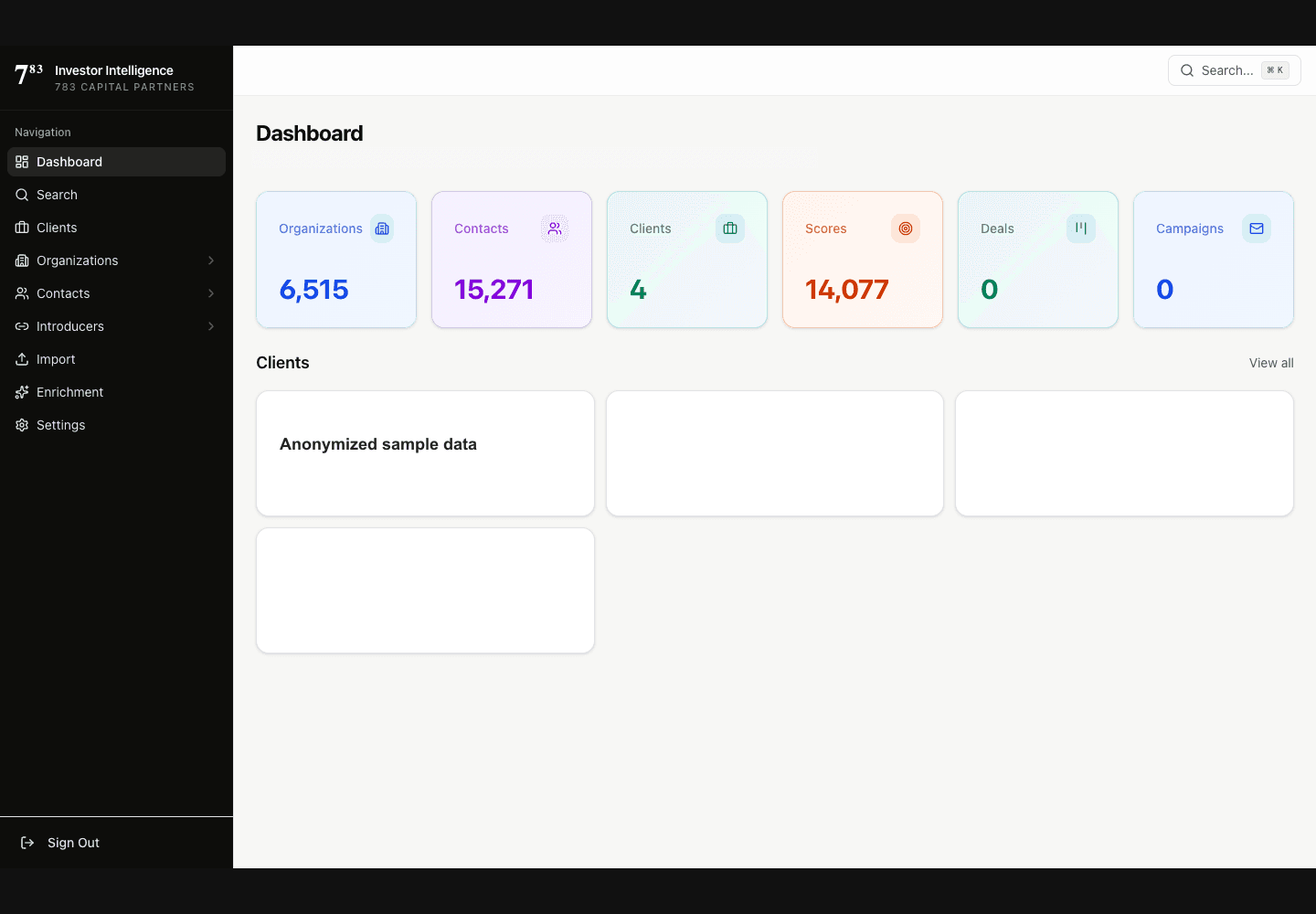
Investor Intelligence
Investor Intelligence
A private intelligence layer for organizing organizations, contacts, introducers, scoring, enrichment, and campaign activity.
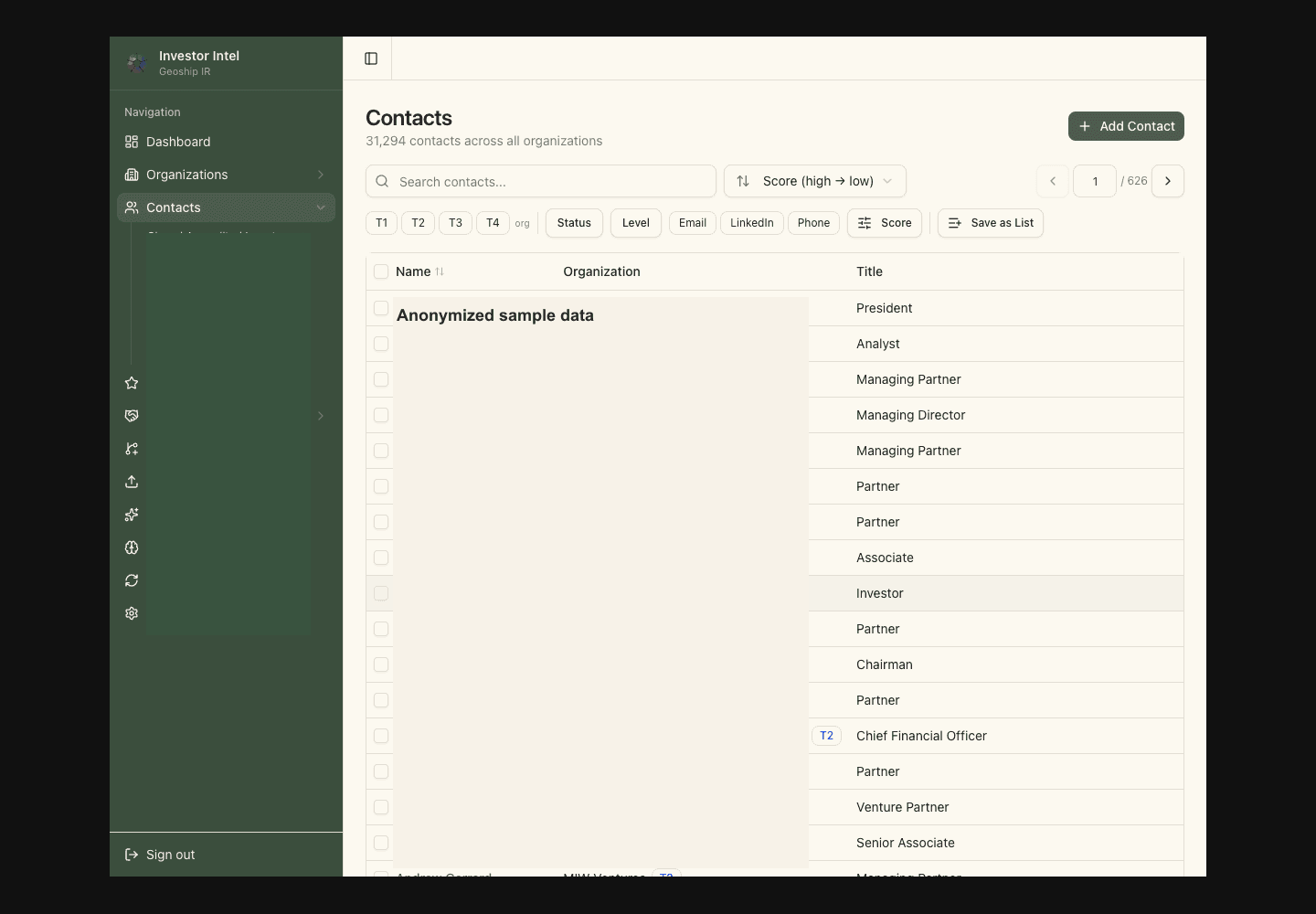
Investor Intelligence
Radar
An investor relations platform for consolidating, enriching, scoring, and managing prospective investors for Geoship's fundraising work.
Digital Marketing
Alistair Langer
From Email Migration to Full-Spectrum Business Partnership
More in Investor Intelligence
- AssessmentInvestor Intelligence AuditA ranked, enriched view of your own network inside a week.One week
- BuildCRM Sync and Pipeline AnalyticsYour platform and your CRM finally agree, and the pipeline shows real velocity.One to two weeks
- BuildContact Enrichment and ConsolidationOne clean, enriched contact set from every place your relationships currently live.Two to three weeks
Questions
How is the scoring model built?
The model starts as deterministic rules you can read line by line, built and tuned together with you against real examples from your own pipeline. We bring in a language model only where judgement is genuinely needed, such as reading an unstructured bio for relevant signal. Every score still traces back to a reason.
Can it run more than one model?
Yes. The platform supports one scoring model per thesis or portfolio company, all running against the same underlying data. A contact can rank highly against one thesis and low against another, which is often the more useful answer than a single blended score.
What does it cost to run?
Enrichment is passed through at cost, and it is usually a small ongoing figure relative to the build itself. The only other running cost is hosting, which sits in infrastructure you own rather than a recurring fee to us.
Who maintains it?
Your own team can maintain it once handed over, since the system and its documentation are built for that from the start. If you would rather not, we can operate it for you as a monthly arrangement instead.
