Loading…
Loading…Growth Operations · Retainer
Monthly Growth Optimisation
Three to five changes a month, shipped and measured, with a written record of why.
A monthly cadence on top of your observability data: we review every source, propose three to five specific changes, ship the ones you approve, run the experiments, and write up what happened. The layer most agencies stop before. Requires the observability setup or an equivalent.
Discuss this engagementWho this is for
- Businesses with meaningful revenue from the web
- Teams who received recommendations before and nothing shipped
- Founders who want improvement without managing it
The situation
A website is sharpest on the day it launches and drifts from there. Copy goes stale, a page that used to convert quietly stops, a competitor changes their offer and nobody on your side notices for months. Nothing breaks in a way that trips an alarm; the business just slowly performs a little worse than it did on day one.
Most businesses have already paid for a diagnosis of this. A consultant or an agency delivered a list of recommendations, and the list is still sitting in an inbox because nobody had the hours to build any of it. Advice without a hand attached to build it becomes a report, not a result.
What changes
Every month, the site gets reviewed against real numbers, three to five specific changes get proposed, and the ones you approve get built and measured. None of it depends on a single big swing landing perfectly; the value comes from the string of smaller ones that keep landing. Nothing waits for a big relaunch that might never get scheduled; the next change ships as soon as it is approved, whether that takes a week or a month.
Compounding works in a growth programme the way it works in a bank account: small, repeated gains outrun one large leap that never comes again.
Six months in, the site is not the one that launched. Every change is dated, every result is recorded, and a leader can trace exactly which decision moved which number, with the evidence sitting in the data itself.
How it runs
- 01
Review all sources against last month
- 02
Propose three to five changes with expected effect
- 03
Ship approved changes and set up experiments
- 04
Report what moved and what did not
The review comes first every month, run against the full data set rather than a sample, so a recommendation is grounded in what actually happened last month and a hunch about what usually works never gets the final say.
Approved changes ship the same month, each one set up as a measurable experiment rather than a change made on faith. What moved and what did not both get written into the report, so a change that failed to help is recorded as clearly as one that worked. The same experiment framework applies whether the change is a headline rewrite or a full page redesign, so results stay comparable month over month.
What you receive
The changes themselves, shipped and live rather than sitting in a backlog, each one tied to the number it was meant to move. Every experiment's result is recorded, win, loss or inconclusive, so the record of what was tried is as complete as the record of what worked.
And the report itself: one page, written for a leader who has two minutes, showing what shipped, what moved, and what is queued for next month. Read across a year, the reports become a written history of how the site actually improved, one decision at a time, with nobody having to remember what happened last quarter from memory alone.
The engagement
- Format
- Monthly review, written recommendations, implementation of approved changes, experiment tracking, a one-page narrative report
- Duration
- Monthly
- Typical range
- Engagements in this shape typically run $1,500 to $3,000 a month.
- What we need from you
- One working session a month
- Decisions on the changes we propose
- Access to ship changes, or a developer who can
Related work
Operating System
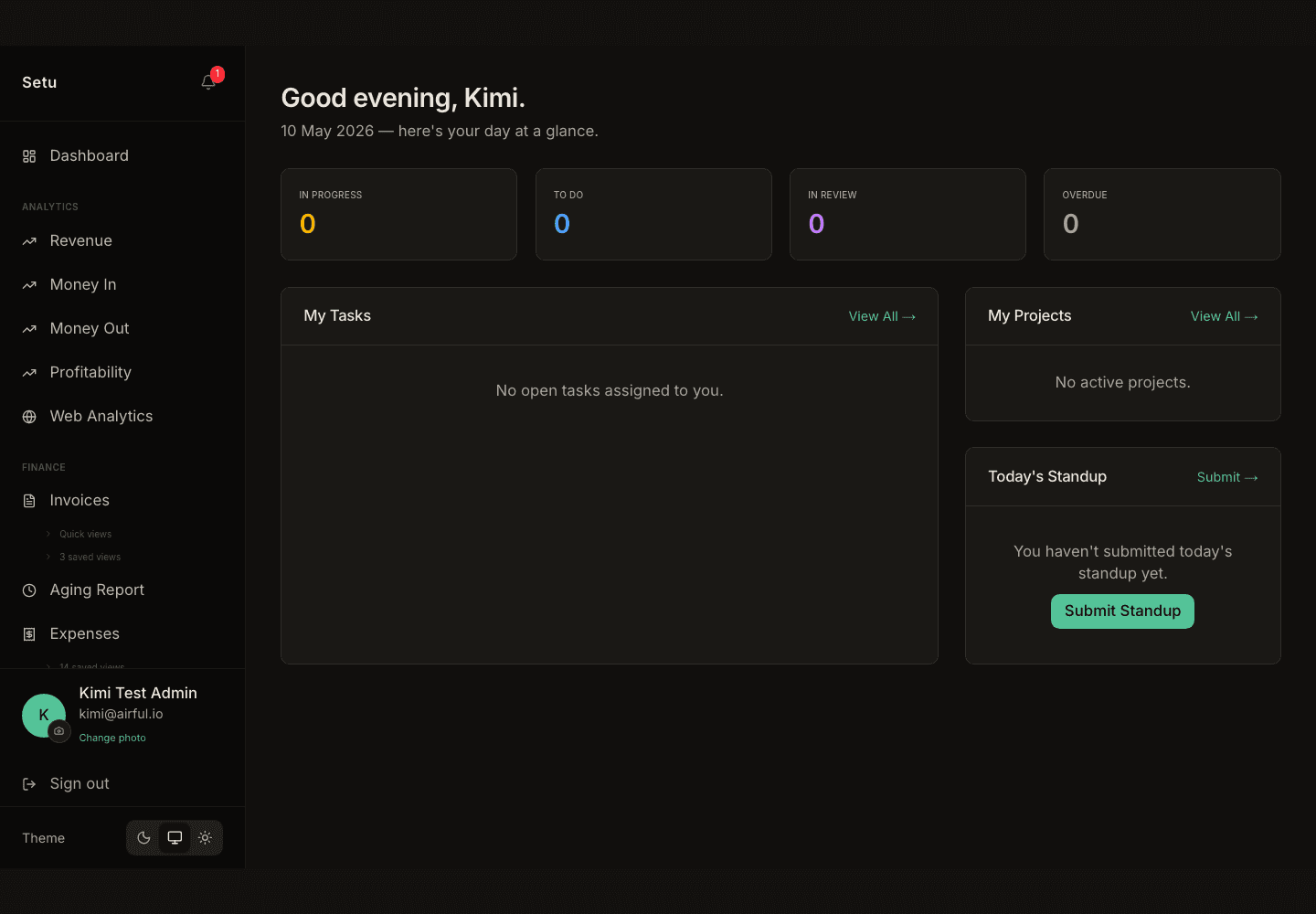
Setu Ops Platform
A unified operations platform and client portal for Airful, replacing fragmented workflow tools with a Supabase-backed operating layer.
Digital Marketing
Alistair Langer
From Email Migration to Full-Spectrum Business Partnership

Digital Marketing
Tempest House
Strategic Growth Partnership
More in Growth Operations
- BuildGrowth Observability SetupEvery source of growth data flowing into one place, daily, before you decide anything.Two weeks
- ProgrammeConversion Rate OptimisationThe three biggest leaks in your funnel found, tested and fixed in four weeks.Four weeks
- ProgrammeAI Skills Training for Business OwnersYou and your team using AI tools properly inside your own work, by the end of the day.One day to three sessions
- RetainerFractional Technology LeadershipSenior technology and product direction, a fixed number of days a month, with a plan to hand over.Monthly
Questions
What do we get each month?
Each month you get a full review of your data, three to five recommended changes, and the ones you approve shipped and tracked as experiments. Every experiment is measured against your own numbers, producing evidence you can check for yourself. It closes with a one-page report, written in plain language, that a leader can read in two minutes.
Do you implement or only recommend?
We implement the changes you approve. A developer on our team, or yours, ships the change, and its effect gets measured the same month it goes live. The record shows what happened, with the reasoning behind each change written down.
Can we pause?
Yes, the retainer runs monthly and you can pause it with thirty days notice. There is no lock-in beyond that window, and resuming later starts from the same observability data, already current. Nothing about pausing puts the underlying setup at risk.
How is this different from an agency retainer?
It is measured against your own data, every month, in writing. Every recommendation is a specific change tied to numbers you can check yourself, both before it ships and after. The report is written for someone making a decision, in the time it takes to read one page.
