Loading…
Loading…AI Innovation
AI Operating Systems: Why the Next Billion-Dollar Companies Will Be AI-Native
An AI Operating System lets software operate on behalf of people, not just assist them — why the next billion-dollar companies will be AI-native.
Avishek Kedia
Founder & CEO, Airful
A prospect asked me last month whether they should "add some AI" to their operations. I asked what they meant. They wanted a chatbot on the website and a tool to summarize their meetings. Both fine ideas. Neither one would change how their company actually works.
That conversation happens constantly right now, and it captures the mistake most organizations are making. They're treating AI as a feature to add, when the real shift is a new operating model to adopt.
For forty years, software has been built on one assumption: humans are the operators, and computers are the tools. The next decade quietly inverts that. The companies that win it won't be the ones with the most AI features. They'll be the ones whose operations are run by an AI Operating System.
Quick answer
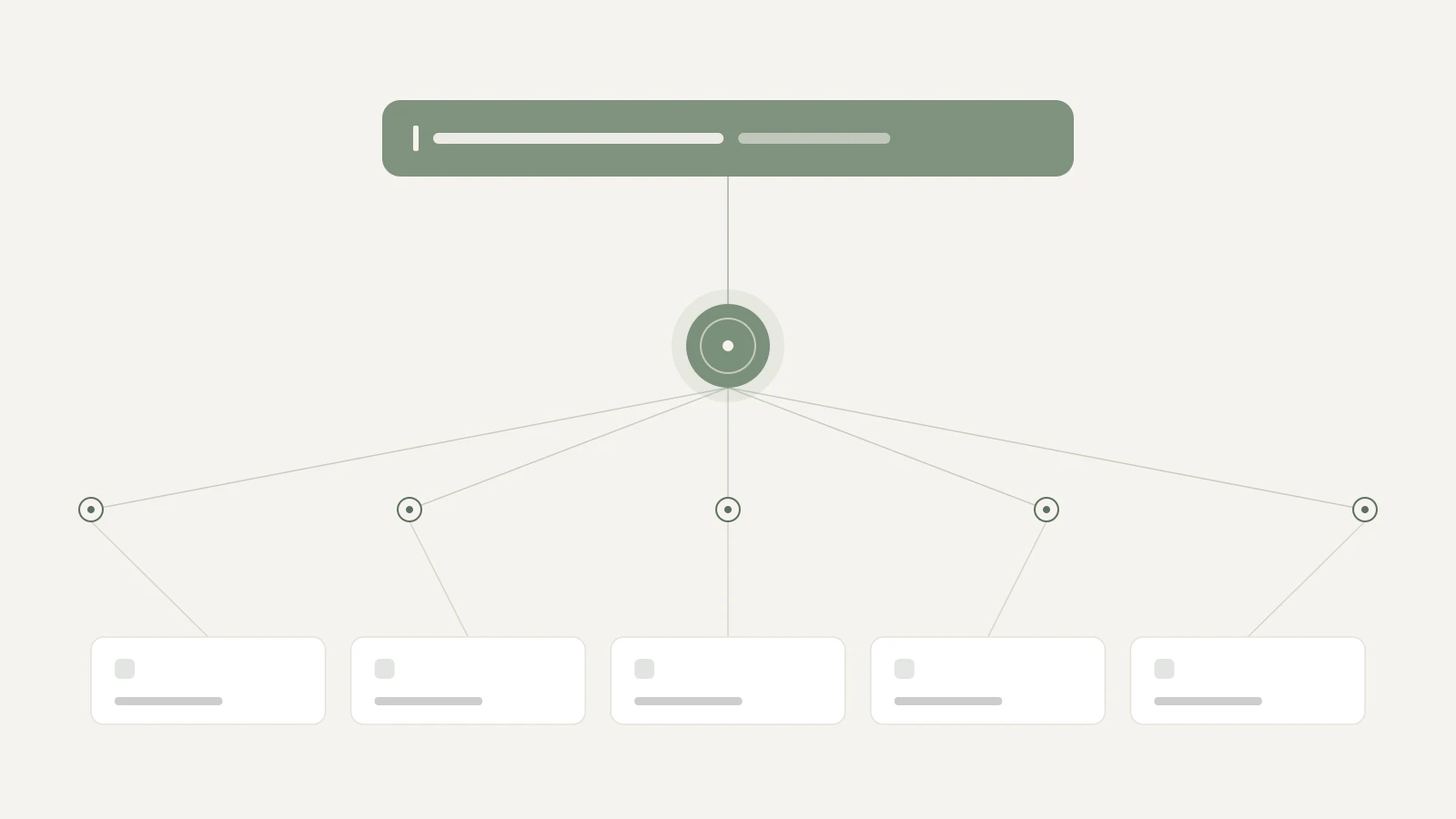
An AI Operating System (AIOS) is a layer that lets software operate on behalf of people instead of waiting for people to operate it.
It connects your enterprise applications, your company knowledge, and your business rules to a set of coordinated AI agents. You give it an objective; it breaks the objective into tasks, coordinates specialized agents across your systems, monitors the outcome, and reports back — while humans set strategy and keep control. The shift is from software that assists work to software that executes it.
The end of software as we know it
Every operating system you've used — Windows, macOS, Linux — was designed to help a person interact with hardware. Enterprise software inherited the same shape. CRM, ERP, project management, communication tools: all of them are interfaces for humans to view information, make decisions, and execute work by hand.
As businesses digitized, the software got more sophisticated, but the operating model never changed. People still spend their days switching between applications, copying information from one to another, updating records, sitting in coordination meetings, and manually moving work between departments. The average knowledge worker now touches dozens of applications a day, and every handoff between them is done by a human.
AI is starting to change this. But most organizations are still treating it as another feature rather than a new paradigm. Bolting a chatbot onto an existing app, or automating a few repetitive tasks, improves productivity at the margins. It does not change how the business operates.
The shift isn't helping people use software more efficiently. It's software operating on behalf of people.
This is the same category of change as the last few platform shifts. The internet changed how businesses communicated. Cloud computing changed how they deployed software. Mobile changed how customers interacted with services. AI Operating Systems change how the work itself gets executed.
Humans stay responsible for strategy, governance, creativity, and the decisions that carry real risk. AI becomes the operational partner that coordinates everything underneath.
The AI revolution isn't about better chatbots
Almost all of the public conversation about AI is about the visible surface: chatbots, image generation, coding assistants. Useful, but it's the tip of the iceberg.
Today's AI tools are assistants. They wait for a prompt, complete a task, and stop. That reactive model is genuinely helpful, and it's also a ceiling. An AI Operating System moves past it by coordinating many AI capabilities across the whole organization toward a goal.
Here's the difference made concrete. Imagine you could ask your business:
"Prepare next quarter's sales forecast, identify the customers at risk of churn, build personalized retention campaigns for them, update the CRM, notify the account managers, and put together a board-ready presentation."
In a traditional software environment, that's several people working across four or five applications over the better part of a week.
In an AI Operating System, it's a single objective. Specialized agents pull the data, analyze customer behavior, generate the forecast, draft the campaigns, write back to your CRM through its API, alert the right account managers, and produce the executive summary — inside a governed workflow that keeps a human informed and able to intervene at every step.
That's not automation. Automation runs one fixed path. This is orchestrated intelligence: a goal decomposed into tasks, distributed across agents, executed across systems, and supervised by people. If you want the deeper mechanics of how individual agents reason and act, we wrote about that in why agentic AI is becoming essential for startups, and the connective tissue that lets agents reach your tools safely is exactly what MCP is built for.
Why traditional software is reaching its limits
Enterprise software has delivered enormous value, and it's also starting to show structural strain.
Most organizations run on a patchwork of specialized applications. Marketing has its platform, finance has another, sales another, support another. Real knowledge ends up scattered across documents, dashboards, inboxes, and conversations that never make it into any system at all.
As a company grows, that fragmentation compounds into a predictable set of problems:
- People spend more time searching for information than acting on it.
- The same data drifts out of sync across systems.
- Workflows need constant manual coordination between departments.
- Decisions slow down because the context is spread across a dozen tools.
- Operational and technical complexity quietly accumulates with every new hire and license.
The usual response is to buy more software. But adding tools to a fragmentation problem usually deepens it — a pattern we've watched play out enough times to write a whole piece on the real cost of tool sprawl. More dashboards don't fix a coordination problem; they just add more places to look.
An AI Operating System attacks the problem from the other side. Instead of asking humans to coordinate the software, it coordinates the software itself. By connecting enterprise applications, organizational knowledge, business rules, and autonomous agents into one intelligence layer, an AIOS becomes a system that understands context, reasons across workflows, and acts — rather than another window for a person to manage. It's the natural endpoint of a trend we've described before: the dashboard layer dissolving as AI reads the underlying systems directly.
We help companies move from AI-assisted to AI-native — connecting the tools you already run into a coordinated operating layer instead of adding yet another app. If you're trying to figure out where an AI Operating System actually fits in your business, that's the conversation we have best.
Book a Free Discovery SessionWhy this matters
The next generation of billion-dollar companies probably won't be defined by how many people they employ or how many software licenses they hold. Their advantage will come from how effectively they combine human expertise with AI-native operations.
This is the part worth sitting with. Companies that keep treating AI as an add-on will get incremental productivity gains — real, but bounded. Companies that redesign themselves around an AI Operating System get to rethink the more fundamental questions: how work is organized, how decisions are made, how value is created in the first place.
The economics are what change. AI-assisted businesses still scale mostly by adding headcount; more output means more people. AI-native businesses scale through knowledge and computation. When a new objective arrives, the marginal cost of executing it is closer to compute than to a new hire. That's a different cost curve, and over a few years a different cost curve becomes a different company.
This transition is still early. But the direction is getting hard to miss. Just as cloud computing became the foundation of the modern digital business, AI Operating Systems are becoming the foundation of the next generation of intelligent enterprises. The work of redesigning operations around them is what separates companies that will compound from companies that will merely keep up — and it's most of what our studio spends its time on.
The question for most leaders isn't whether this shift happens. It's whether their company is one that adopts the new operating model early, or one that spends the next few years adding features to the old one.
Frequently asked questions
What is an AI Operating System (AIOS)?
An AI Operating System is a layer that lets software operate on behalf of people instead of waiting for them to operate it. It connects enterprise applications, company knowledge, and business rules to a set of coordinated AI agents that can take an objective, break it into tasks, act across systems, and report back — with humans setting strategy and keeping control.
How is an AIOS different from a chatbot or an automation?
A chatbot is reactive: it answers a prompt and stops. An automation runs one fixed workflow. An AI Operating System is orchestrated: it takes a high-level objective, plans the steps, coordinates multiple specialized agents across different applications, monitors the outcome, and adjusts. The unit of work is an objective, not a single message or a single trigger.
Will AI Operating Systems replace employees?
Not in the way people fear. AIOS replaces the manual coordination work — copying data between tools, chasing updates, stitching workflows together — not human judgment. People stay responsible for strategy, governance, creativity, and critical decisions. The model shifts headcount-led scaling toward computation-led scaling, which changes the economics more than the org chart.
What makes a company AI-native rather than AI-assisted?
An AI-assisted company bolts AI features onto existing software and processes. An AI-native company redesigns how work is organized around an AI Operating System: objectives flow in, agents coordinate execution across systems, and humans supervise. The difference shows up in economics — AI-native operations scale through knowledge and compute instead of additional headcount.
Do I need to replace my existing software to adopt an AIOS?
Usually not. An AI Operating System sits on top of the tools you already run and coordinates them through their APIs. The goal is not to rip out your CRM or ERP — it is to stop asking humans to be the integration layer between them. You connect existing systems, knowledge, and rules into one intelligence layer that can reason across all of them.
Related Posts
How to Check What AI Says About Your Business
A repeatable, tool-free way to audit what ChatGPT, Perplexity, Claude, Gemini and Google AI Overviews say about your business, and what to fix first.
llms.txt: What It Is and Whether It Helps
llms.txt is a Markdown file that maps a website for AI agents. It costs little to publish, and no major assistant has committed to reading it.
The Design Principles of AI-Native Companies
AI-native companies are designed around objective-first workflows, source-of-truth discipline, narrow agents, explicit handoffs, audit trails, and continuous measurement.

Ready for a clearer growth plan?
Book a 30-minute audit call. We review your current stack and recommend the first module. No generic sales pitch, no 12-page proposal.