Loading…
Loading…Growth Operations · Build
Process and Workflow Automation
The weekly task that eats your team's afternoon, gone by next month.
We map the repetitive work in your operation, pick the two or three processes worth automating first, and build them: intake, routing, reminders, document generation, reconciliation, reporting. Built on the tools you already run, with a person kept in the loop where judgement matters. One to three weeks.
Discuss this engagementWho this is for
- Small teams drowning in manual steps
- Operations leads with a list of things that should just happen
- Founders paying people for copy-and-paste
The situation
Somewhere in the business is a task that happens the same way every week and has for years: an intake form gets re-typed into your second system, a reminder gets sent by hand from memory, an invoice gets reconciled line by line against a bank statement. Nobody questions it anymore. It has been done this way long enough to feel inevitable rather than chosen.
The cost shows up in two places. The obvious one is the afternoon it eats every week, usually from whoever is most reliable and therefore most likely to be handed the boring thing. The quieter one is the error that only surfaces when a customer complains, because nobody was watching the step closely enough to catch it first.
What changes
The task still happens, only now a system you own does the repeatable part while a person checks the result before it goes anywhere that matters. Intake routes itself, reminders fire on schedule, documents generate from data that is already correct because it was typed once, not five times.
The clearest sign a process is ready to be built once and repeated forever is that everyone already knows exactly what happens next, every single time.
What used to disappear into a person's afternoon now takes minutes, and the minutes it does take go to the exceptions: the case that does not match the pattern, the one that genuinely needs a judgement call. Those get flagged and handed to a person, clearly marked, so they never blend into a queue of routine work that looks the same from the outside.
How it runs
- 01
Map the processes and measure the time
- 02
Rank by frequency, rules and error cost
- 03
Build the first two or three with logging and alerts
- 04
Run in parallel, then switch over, then hand over the runbook
We start by mapping the processes as they actually run today, not as anyone remembers describing them in a meeting once, and timing how long each one actually takes across a normal week. That mapping session usually surfaces one or two processes nobody had mentioned before, because the person doing them had stopped thinking of the work as unusual.
The ranking is not a guess. Frequency, how rule-based the steps are, and the cost of a mistake each get weighed, and the two or three processes at the top of that list are the ones we build first, with logging and an alert built into the first version from the start.
What you receive
You receive the automations themselves, live and running on the tools you already use, handling the two or three processes that were costing the most time or producing the most errors. Each one logs what it did and alerts a person the moment it hits a case outside what it was built to handle.
Alongside them, a runbook written for whoever owns the process day to day: what the automation does, what triggers a manual check, and how you extend it when the process itself changes. A short monitoring view lets you see what ran, what got flagged, and what still needs a person, so the whole automation stays visible even once it is running well.
The engagement
- Format
- Process mapping session, priority list, build of the agreed automations, monitoring and a runbook
- Duration
- One to three weeks
- Typical range
- Engagements in this shape typically run one to three weeks and $1,500 to $7,500.
- What we need from you
- A walkthrough of the processes and the people who run them
- Access to the tools involved
- A decision on where a person must remain in the loop
Related work
Operating System
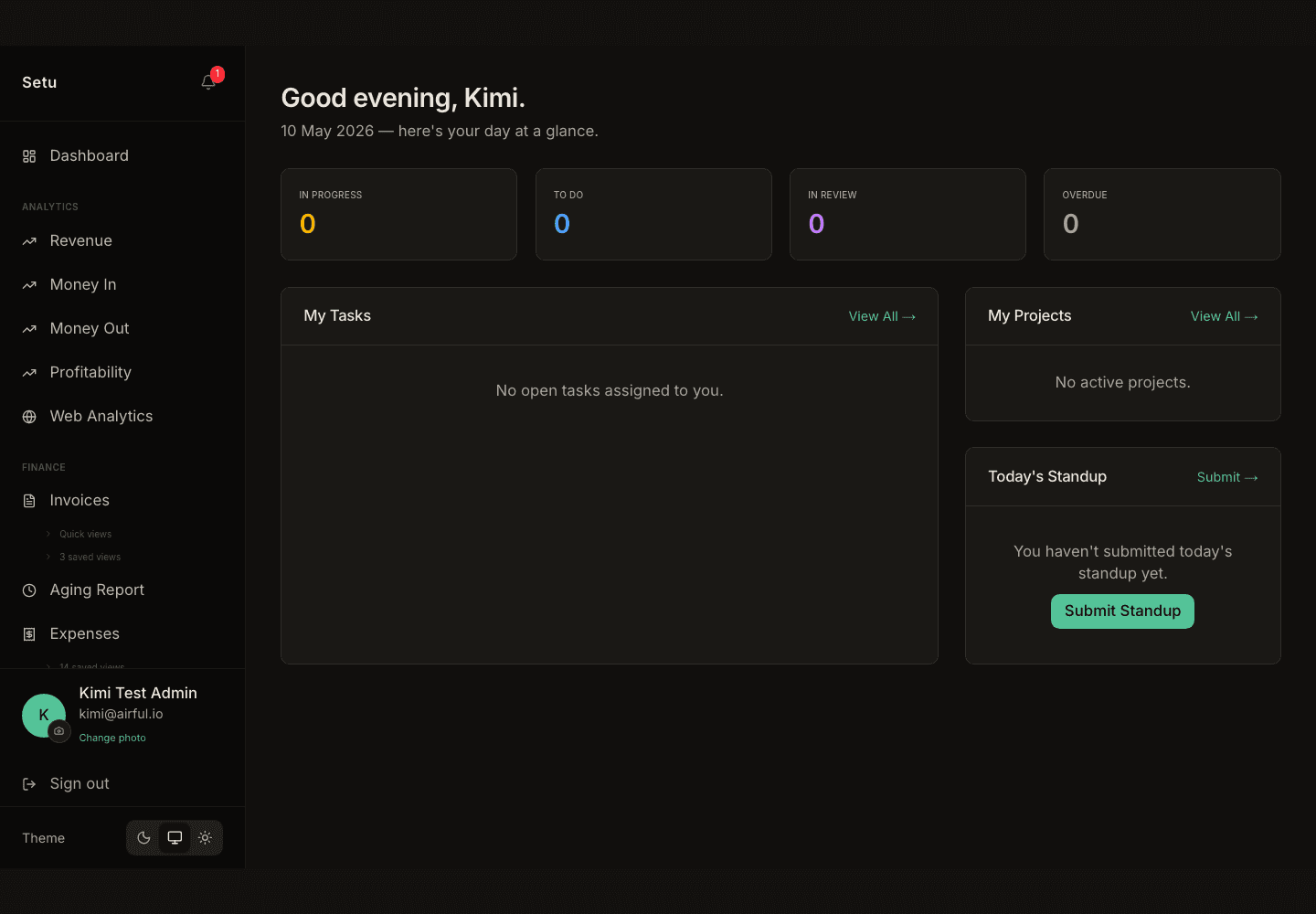
Setu Ops Platform
A unified operations platform and client portal for Airful, replacing fragmented workflow tools with a Supabase-backed operating layer.
Digital Marketing
Alistair Langer
From Email Migration to Full-Spectrum Business Partnership

Digital Marketing
Tempest House
Strategic Growth Partnership
More in Growth Operations
- BuildOperations Platform for OperatorsA back office built around how you actually work, live in days, run with you for years.One to eight weeks
- ProgrammeAI Skills Training for Business OwnersYou and your team using AI tools properly inside your own work, by the end of the day.One day to three sessions
- RetainerFractional Technology LeadershipSenior technology and product direction, a fixed number of days a month, with a plan to hand over.Monthly
- BuildGrowth Observability SetupEvery source of growth data flowing into one place, daily, before you decide anything.Two weeks
Questions
Which processes are worth it?
The processes worth automating first are the ones that happen often, follow clear rules, and produce errors when someone on your team does them by hand. We map every candidate process with you and rank them by frequency, rule-clarity and the cost of a mistake. The ranking becomes the build order, agreed together before any code gets written.
Do you use no-code tools?
We use no-code tools where they fit the process cleanly and hold up under real volume. For anything with more complex logic or a real error cost, we write code, and we tell you which choice we made and why. Either way, you get an automation built to last, with the reasoning documented.
What if it breaks?
Every automation we build logs what it did, alerts someone if a step fails, and defaults to a person whenever it hits a case it was not built for. Nothing fails silently. You can see exactly where a run stopped and pick it up by hand within minutes.
Will our team lose control?
No, your team keeps every decision that actually needs a person; the automation only takes over the repetitive steps around it. What changes is the time available for the judgement calls that were getting crowded out by data entry. The exceptions the automation cannot handle still land on your desk, flagged and ready for someone to review.
