Loading…
Loading…Operational Platforms · Build
Operations Platform for Operators
A back office built around how you actually work, live in days, run with you for years.
A custom operations platform for founder-led businesses: contacts and clients, enquiries and pipeline, bookings, documents, newsletters and payments in one place, built on a template we have run many times and shaped to your workflow. From a five-day setup to a full multi-role build.
Discuss this engagementWho this is for
- Solo operators and small teams running the business from spreadsheets and inboxes
- Multi-property or multi-brand operators who need one team in one system
- Founders replacing three tools that do not talk to each other
The situation
The business runs, but it runs from the founder's memory. Which enquiry is warm, which client is due a follow-up, which booking still needs a deposit chased: all of it lives in a head, an inbox, and a spreadsheet that only makes sense to the person who built it. Ask a new hire to take over any of it and the answer is usually that they cannot, because nothing has been written down in a form another person could pick up.
Meanwhile the business is paying for three or four tools that do not talk to each other: one for enquiries, one for bookings, a spreadsheet for the pipeline, a folder somewhere for contracts. Moving a single client from first message to signed agreement means re-entering the same facts in each place, and the version that is out of date is usually the one someone trusted.
What changes
You get one system your team actually lives in, covering contacts, enquiries, pipeline, bookings, documents and payments in a single place. A new hire can see the state of any client or booking without asking the founder, because the record is written down where the work happens, not held in someone's head.
An operations platform is working when the founder is no longer the system everyone else depends on.
Routine work stops needing the founder as a bottleneck. Enquiries route themselves to the right person, follow-ups fire on schedule, and documents generate on their own from the data already in the system, without being drafted from scratch each time. The founder's attention moves to the decisions that actually need it.
How it runs
- 01
Map the workflow and the data you already have
- 02
Stand up the template or the foundation
- 03
Shape modules to your process: pipeline, bookings, documents, comms
- 04
Migrate data and train the team
- 05
Run it with you, monthly, if you want that
We start from a template we have run for other operators, which is why a working version exists inside a week rather than a month. The weekly session after that is where the platform gets shaped to you specifically: which pipeline stages matter, which documents need to generate themselves, which bookings need a deposit rule the template does not assume.
Data migration happens once the shape is agreed, so nothing has to be re-entered when a field changes. Training runs against real records from your own business, not sample data, because a team learns a system faster when the first thing they see in it is a client they recognise.
What you receive
The platform itself, deployed and running on infrastructure billed to you, with your team already trained on the parts they use daily. Your existing data, migrated and checked against the source rather than assumed correct, so the system is trustworthy from the first day, with nothing left to verify later.
A short manual, written in plain language for the people who will use the platform day to day. And the repository, handed over in full, so the platform remains yours to run, extend or hand to someone else regardless of whether the monthly relationship continues afterward.
More than ten operating platforms and CRMs built for operators
More than twenty-five documented engineering patterns reused across client work
The engagement
- Format
- Template-based setup or phased custom build, weekly working session, your own repository and database, optional monthly operation
- Duration
- One to eight weeks
- Typical range
- Engagements in this shape typically run one to eight weeks and $5,000 to $25,000.
- What we need from you
- A walkthrough of how work actually flows today
- Access to the tools being replaced or connected
- A decision-maker for weekly sessions
- Continues as
- Monthly Growth Optimisation
Related work
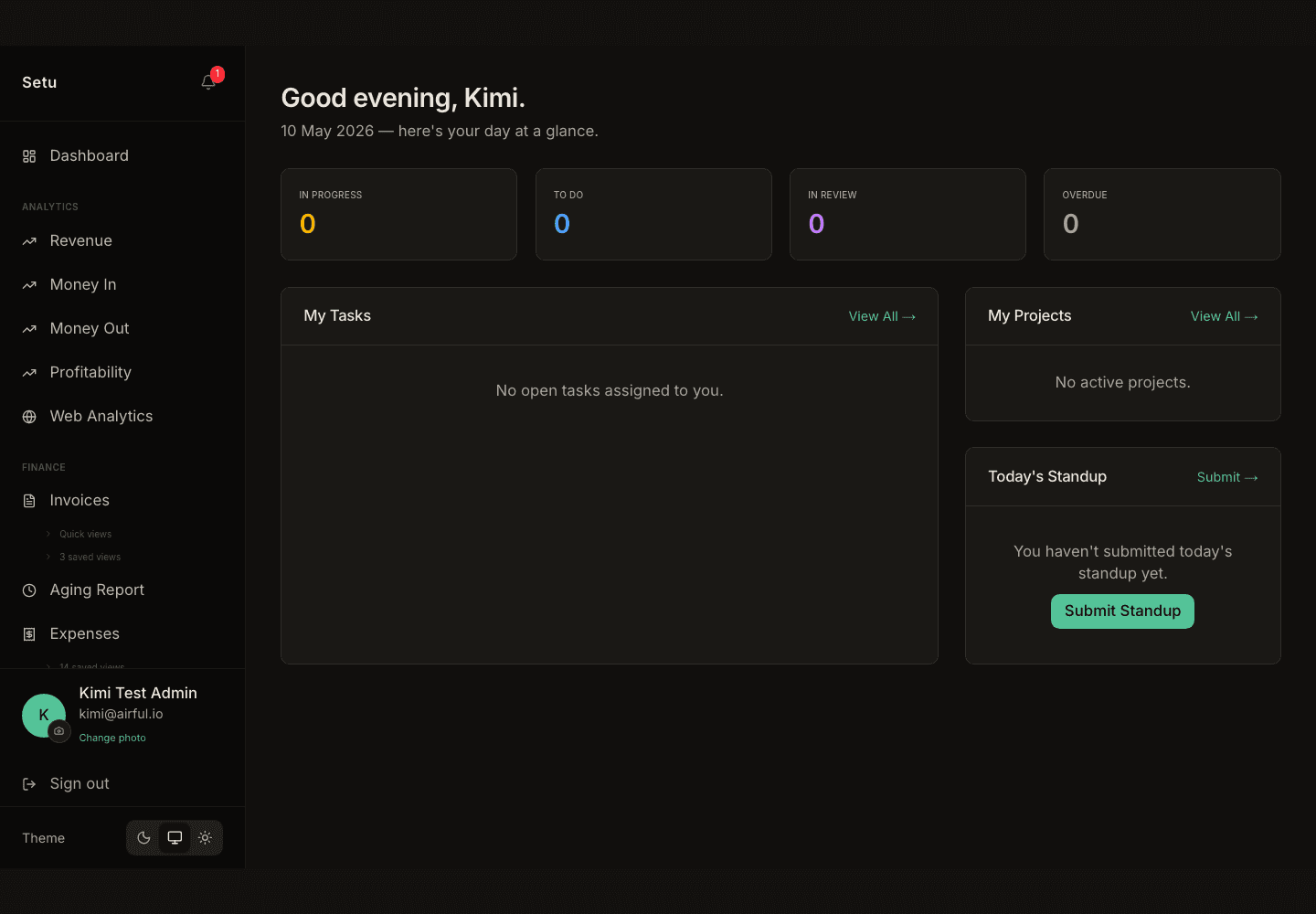
Operating System
Setu Ops Platform
A unified operations platform and client portal for Airful, replacing fragmented workflow tools with a Supabase-backed operating layer.

Web Development
Le Roma Gardenia
From Vision to Luxury Destination
Digital Marketing
Alistair Langer
From Email Migration to Full-Spectrum Business Partnership
More in Operational Platforms
- BuildWhatsApp Operations LayerEvery message answered, recorded and attributed, no matter whose phone it landed on.Two to three weeks
- BuildCRM Sync and Pipeline AnalyticsYour platform and your CRM finally agree, and the pipeline shows real velocity.One to two weeks
- BuildIntelligence Features in ProductThe feature your users expect now: matching, summarising, classifying, answering, built to be trusted.Two to four weeks
- BuildPlatform MigrationOff the tool you have outgrown, onto a stack you own, without losing a single URL.Two to six weeks
Questions
Why not a generic CRM?
Generic tools shape your work to their model; this is shaped to yours and costs less to run. A pipeline stage, a booking type or a document flow that does not match how you actually operate gets built to match it, so your team is never asked to adapt to a stranger's assumptions about the business.
How fast is the template version?
A working platform inside a week from access being granted, covering contacts, pipeline, bookings and documents on the foundation we have already built and tested elsewhere. From there, further weeks go entirely to the modules specific to how you run things; the parts every operator needs are already built.
What does it cost to host?
A few tens of dollars a month on infrastructure you own. There is no per-seat licence to climb as the team grows: you hold the account and the bill, and nothing about your data sits behind a vendor's pricing decision made after you are already committed.
Can it grow into a product?
Yes, several have. What starts as an operator's own back office can become the product they sell, once the workflow is proven on their own business.
